
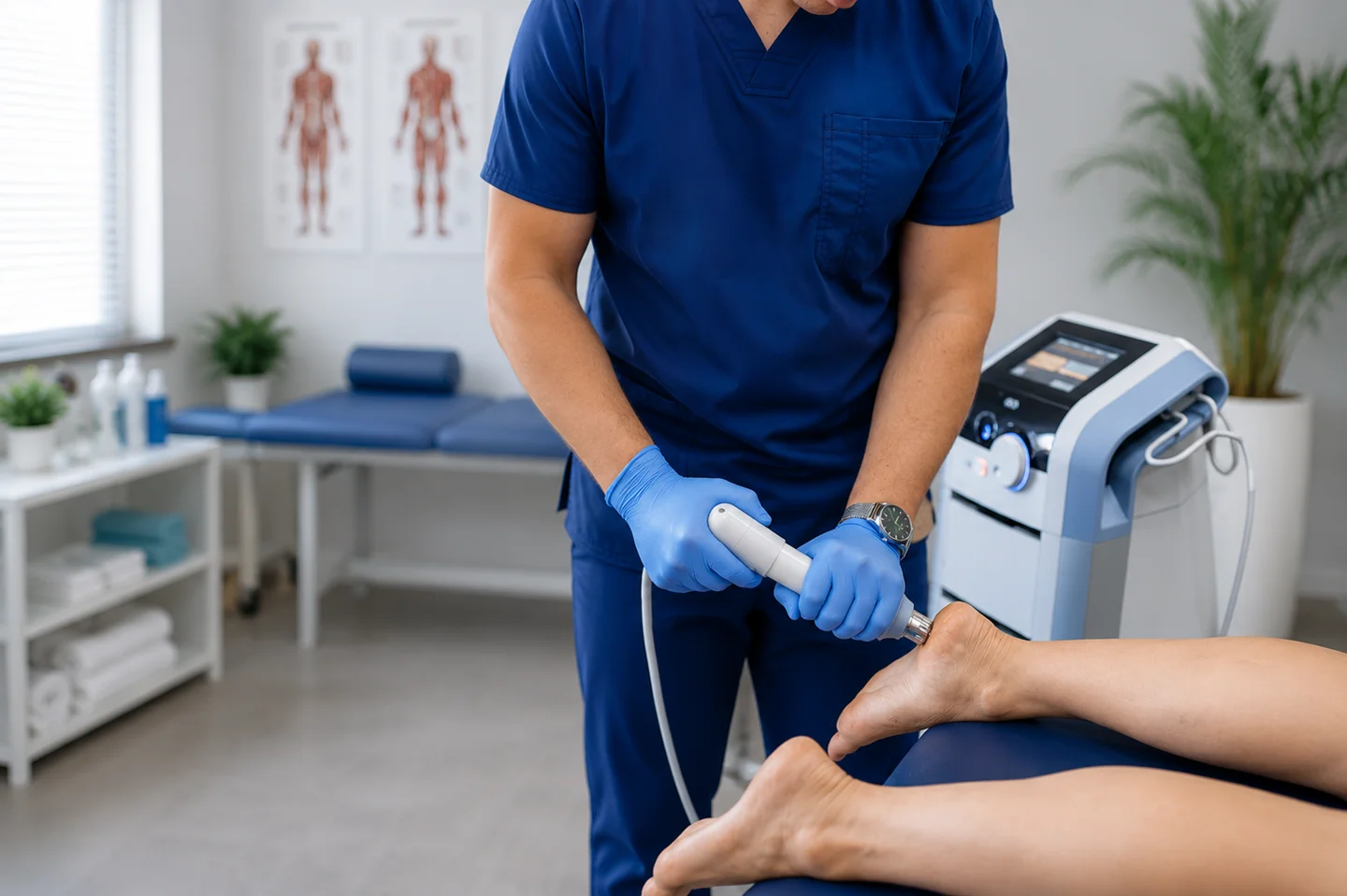
Shockwave is a non-surgical treatment that applies mechanical pressure waves to a specific area. At Salbar Fysiotherapie in Vinkeveen, physiotherapist Boris Feldman primarily uses shockwave as an additional treatment for certain persistent tendon and tendon attachment symptoms. Shockwave is not a general treatment for pain. The first step is therefore always to assess what is happening and determine whether shockwave is actually useful for your condition.
For which symptoms might shockwave be considered?
Shockwave is mainly researched and used for certain tendinopathies and tendon attachment conditions. Depending on the individual assessment, shockwave may be considered for:
- Achilles tendon problems;
- heel pain and fascia-related symptoms;
- tennis elbow;
- certain rotator cuff symptoms;
- calcifications around the shoulder;
- gluteal tendon symptoms;
- and some other persistent tendon problems.
Not every tendon condition responds to shockwave in the same way. The diagnosis alone is therefore insufficient to determine whether the treatment is suitable.
How does shockwave work?
A shockwave device delivers short pulses of mechanical energy to the treated area. This stimulus may cause biological and neurophysiological responses that could influence:
- pain;
- local tissue responses;
- and the ability to load the affected structure again.
The precise mechanisms are not yet fully understood. I therefore do not tell patients that shockwave simply “breaks up calcifications”, “shatters scar tissue” or mechanically repairs a tendon. That oversimplifies a complex biological process.
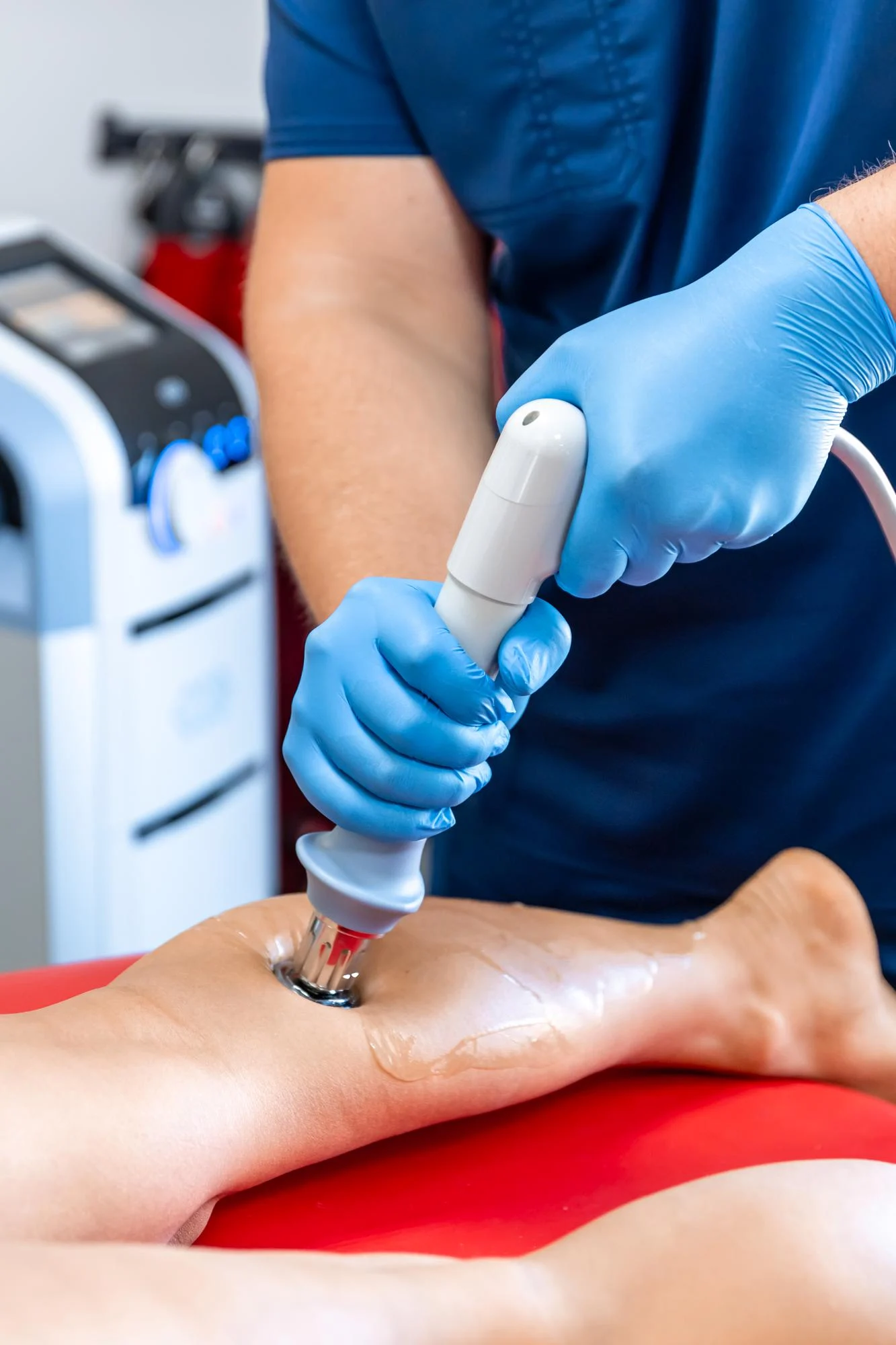
Radial shockwave
Salbar uses radial shockwave. Mechanical energy is delivered to the treatment area through an applicator. Treatment is adjusted to:
- the location of the symptoms;
- sensitivity;
- the response to treatment;
- and the intended dose.
Greater intensity is not automatically better.
Shockwave for Achilles tendon symptoms
Persistent Achilles tendon symptoms usually require an appropriate combination of:
- load management;
- targeted strengthening exercises;
- gradual progression;
- and sufficient recovery time.
Shockwave may be considered as an additional treatment for certain patients. It does not replace the necessary tendon rehabilitation.
Shockwave for heel pain
For persistent plantar heel pain, shockwave may be a treatment option in selected cases. I also consider:
- daily activity loads;
- footwear;
- walking loads;
- calf function;
- foot and ankle mobility;
- and the load capacity of the entire leg.
Treating only the painful area is often insufficient.
Shockwave for shoulder symptoms
Shockwave can be used for certain shoulder conditions, particularly specific tendon-related symptoms and calcifications. However, “shoulder pain” is not a diagnosis. A frozen shoulder, rotator cuff tendinopathy, pain referred from the neck and a postoperative shoulder require completely different treatment strategies. Shockwave is therefore always preceded by a focused assessment.
Shockwave for tennis elbow
For persistent outer elbow symptoms, shockwave may be one treatment option. At the same time, gradually increasing the load on the wrist and forearm muscles remains important. Ultimately, the goal is not merely for the elbow to feel less painful after treatment, but for you to be able to:
- grip;
- lifting;
- work;
- play sports;
- and carry out other activities that place demands on the area.
Shockwave does not replace exercise therapy
This is my most important guiding principle. In many tendon conditions, the affected structure ultimately needs to learn to tolerate loading again. Treatment may therefore consist of, for example: shockwave + exercise therapy + a gradual increase in loading. Not shockwave instead of rehabilitation.
Does shockwave hurt?
Shockwave can feel uncomfortable. The intensity is adjusted to your tolerance and the purpose of treatment. Treatment does not have to be as painful as possible to be worthwhile. “The harder, the better” is not a guiding principle at Salbar Fysiotherapie.
How many treatments are needed?
This varies depending on the symptoms and the patient. Shockwave is not usually continued indefinitely. After a limited number of sessions, it should become clear whether it remains part of a worthwhile rehabilitation plan. If there is no meaningful change, the strategy needs to be reassessed.
When is shockwave unsuitable?
Shockwave is not suitable for everyone. Caution or a different treatment may be necessary in situations such as:
- pregnancy involving the treatment area;
- active infection;
- tumour tissue in the treatment area;
- severe blood clotting disorders;
- certain types of anticoagulant medication;
- recent severe tissue damage;
- damaged skin;
- or situations in which the diagnosis is not sufficiently clear.
I discuss relevant medical conditions and medication beforehand.
What does research say?
Research shows that shockwave can help reduce pain and improve function in various tendon-related conditions. However, results vary between conditions. For example, shockwave does not appear equally effective for every tendinopathy. I therefore do not follow the principle: tendon symptoms = shockwave. Suitability is determined individually.
Assessment first, then shockwave
During the initial assessment, I consider factors including:
- the location and nature of the pain;
- how long the symptoms have been present;
- capacity to tolerate activity;
- movement;
- strength;
- activities that provoke symptoms;
- previous treatments;
- and relevant medical factors.
Only then do we discuss whether shockwave is likely to offer any benefit.
Personal treatment by Boris Feldman
Shockwave at Salbar Fysiotherapie is provided as part of a physiotherapy treatment plan by:
Boris Feldman
Physiotherapist Working in physiotherapy since 1996 The equipment is never the starting point. The clinical assessment determines whether the equipment is used.
Shockwave in Vinkeveen
Would you like to know whether shockwave could help with your symptoms? Book an appointment for a physiotherapy assessment. Salbar Fysiotherapie Boris Feldman – physiotherapist Scholeksterlaan 2 3645 KC Vinkeveen