
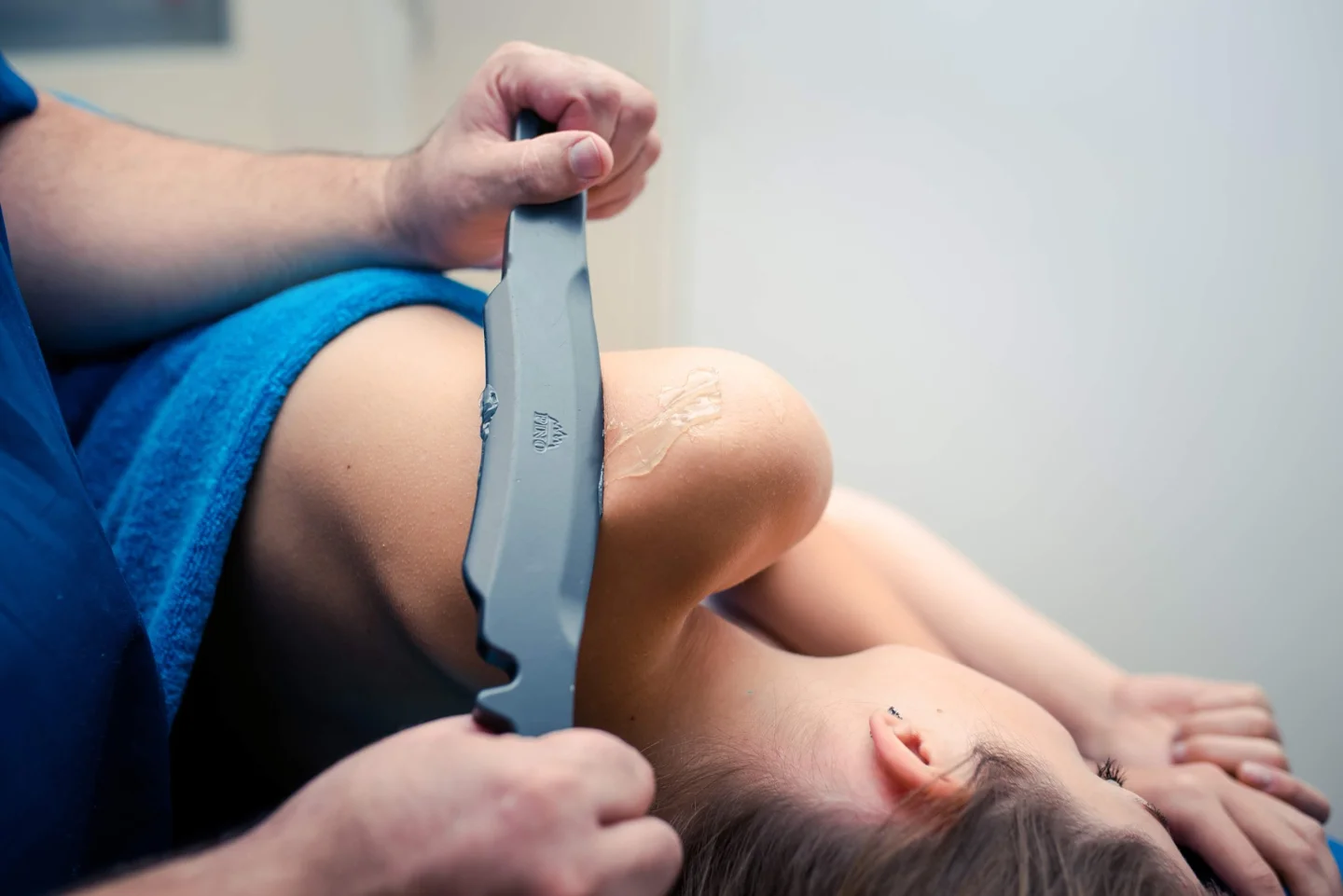
IASTM stands for Instrument Assisted Soft Tissue Mobilisation. In this treatment, the physiotherapist uses specially designed instruments to apply controlled mechanical stimuli to the skin, muscles and other superficial tissues. At Salbar Fysiotherapie in Vinkeveen, physiotherapist Boris Feldman does not use IASTM as a standalone treatment, but as a possible addition within a broader physiotherapy treatment or rehabilitation plan. The aim is not to literally break down so-called adhesions or scar tissue. IASTM may be used when temporarily influencing pain, comfort during movement or range of motion can help you move, exercise and tolerate loading more easily afterwards.
What happens during IASTM?
During an IASTM treatment, a special instrument is moved over or along a specific tissue area. This provides mechanical and sensory stimulation to structures including:
- the skin;
- superficial connective tissues;
- muscles;
- tendon-related structures;
- and the nervous system.
Pressure, direction and treatment duration are adjusted to:
- the symptoms;
- sensitivity;
- location;
- response to treatment;
- and the treatment goal.
The technique does not need to be forceful or painful to have an effect.
Does IASTM break down scar tissue or fascia?
It is still often explained this way. Older theories suggested that an IASTM instrument could mechanically ‘break’ adhesions, fibrosis or scar tissue, after which the tissue would reorganise. There is insufficient clinical evidence for such strong mechanical explanations. Human connective tissue is much stronger than is sometimes suggested. The forces used during normal physiotherapy treatment are not comparable to those that would be required to literally destroy or reshape mature collagen structures mechanically. This does not mean IASTM cannot have an effect. It mainly means we need to understand the effect differently.
How might IASTM work instead?
The precise mechanisms are probably complex and not fully understood. IASTM provides mechanical and sensory input to the nervous system. This may produce temporary changes in areas including:
- pain perception;
- comfort during movement;
- muscle tone;
- sensitivity;
- range of motion;
- and tolerance of loading.
This can create a useful window for treatment. For example, if movement is painful or restricted before treatment and easier afterwards, we can use that change for targeted exercise. This is where I see the value of IASTM. Not treatment to ‘release’ tissue, but using a temporary change to build function.
Which problems can IASTM be used for?
IASTM may be used for selected patients with musculoskeletal problems involving pain, sensitivity or restricted movement. Examples include certain problems around the:
- neck and shoulder;
- elbow and forearm;
- the back;
- the hip;
- thigh;
- the knee;
- calf;
- Achilles tendon;
- the ankle;
- foot.
Local treatment may sometimes also be considered after surgery or injury. However, the presence of a scar does not automatically mean it needs treatment. The question is always: does treating this area provide a functional benefit for this patient?
IASTM for scars
After surgery, a scar may temporarily feel sensitive, firm or less mobile. In certain situations, gentle manual techniques or IASTM may be used to:
- influence local sensitivity;
- make movement more comfortable;
- help the patient gradually become accustomed to touch and loading again;
- or make active movement around the treated area easier.
A scar does not need to be aggressively ‘released’. Scar tissue is a normal part of tissue healing. Treatment is therefore adapted to:
- the stage of healing;
- any surgical instructions;
- sensitivity;
- and the patient’s functional limitations.
A recent scar is never automatically treated intensively with instruments.
IASTM for muscle and tendon problems
For muscle- and tendon-related problems, IASTM may sometimes be used as an additional intervention. However, for many tendon problems, appropriate progressive loading is ultimately especially important. Where relevant, I therefore combine IASTM with elements such as:
- strength training;
- isometric exercises;
- eccentric or concentric loading;
- mobility exercises;
- functional training;
- or a gradual return to sport.
An instrument can support rehabilitation. It cannot replace the training that is needed.
What does research say about IASTM?
Research into IASTM does not provide a completely consistent picture. Recent studies suggest that IASTM may help reduce pain or improve range of motion in some musculoskeletal conditions. At the same time, studies vary considerably in:
- patient groups;
- the instruments used;
- treatment techniques;
- treatment duration;
- dosage;
- and combinations with other physiotherapy treatments.
I therefore do not regard IASTM as a proven universal solution for muscle, fascia or tendon problems. It is one possible intervention within a much broader treatment plan.
IASTM is always evaluated at Salbar
I do not use a technique merely because it could theoretically fit a complaint. Where possible, I assess its effect before and after the intervention. For example: Before treatment: How painful is a movement? How far can you move? Which function is limited? After treatment: Has the same movement changed? Has pain decreased? Is movement easier? If a technique demonstrably adds nothing, there is little reason to keep repeating it indefinitely. Treatment outcomes determine whether a technique remains relevant.
IASTM is not a standalone treatment
A common mistake in manual therapy is allowing treatment to revolve around the same passive technique for years. I want to avoid this. When IASTM is used, I try to connect it to what the patient needs to do afterwards. For example: IASTM -> easier movement -> mobility exercise -> strength -> functional loading. Or: IASTM -> reduced sensitivity -> muscle activation -> training. The technique is a possible intermediate step, not the ultimate goal.
Does IASTM hurt?
IASTM does not need to hurt. You may feel pressure, friction or sensitivity during treatment. The intensity is adapted to your response. Extremely forceful treatment, substantial bruising or the idea that treatment only works if it hurts are not principles of my treatment. More pressure does not automatically mean greater benefit.
Redness or bruising
Mechanical stimulation may temporarily redden the skin. More intensive treatment can sometimes cause small bruises. However, causing bruises is not a treatment goal and is not proof that treatment has been successful. Extra caution is required when a patient bruises easily or takes medication that affects blood clotting.
When do I not use IASTM?
IASTM is not suitable in every situation. Caution or another treatment may be needed in circumstances including:
- open wounds;
- active skin infections;
- recent surgical wounds that have not healed sufficiently;
- acute, severe signs of inflammation;
- an increased tendency to bleed;
- use of certain anticoagulant medication;
- severe vascular conditions;
- suspicious swelling;
- markedly reduced sensation;
- or other medical situations in which mechanical treatment is inadvisable.
Treatment is therefore always preceded by a physiotherapy assessment.
IASTM and fascia
Fascia is connective tissue found throughout the body, surrounding and connecting various structures. In recent years, fascia has often been presented as an explanation for almost every kind of pain. This goes too far. Fascia may be relevant within the musculoskeletal system, but pain is influenced by many more factors. I therefore do not treat a patient solely on the assumption that their fascia is ‘stuck’. The relevant question remains: which structure, movement or load is likely to contribute to the problem, and what can we change functionally?
IASTM and the nervous system
An important part of the effect of manual treatment can probably be explained by the nervous system’s response to sensory input. During treatment, various receptors in the skin and deeper tissues are stimulated. The nervous system processes this information. This may temporarily change the experience of pain or resistance to movement. It helps explain why someone can sometimes move further or more easily immediately after treatment without any literal change to their anatomy. This temporary effect may be therapeutically valuable when it is then used for active rehabilitation.
IASTM at Salbar Fysiotherapie
Boris Feldman has worked with various instrument-assisted soft-tissue techniques for many years. That experience has also led to a change in perspective. Whereas IASTM previously placed considerable emphasis on mechanically treating ‘adhesions’ and ‘scar tissue’, today the emphasis is much more on:
- symptom modulation;
- functional change;
- range of motion;
- capacity to tolerate activity;
- and combining it with active physiotherapy.
For me, this is an important part of continuing professional development. New scientific insights can change a treatment philosophy.
The technique must suit the patient
I do not treat a diagnosis with an IASTM instrument. I treat a patient. Consequently, two people with the same medical diagnosis may receive completely different treatment. One benefits from temporary manual support. Another mainly needs strength training. A third needs explanation and adjustment of loading. Sometimes IASTM is simply unnecessary. A good physiotherapist needs to know not only how to apply a technique, but especially when it is better not to use it.
Personal treatment by Boris Feldman
At Salbar Fysiotherapie, the same physiotherapist supports you throughout treatment. Boris Feldman, physiotherapist, working in physiotherapy since 1996. IASTM is one of the treatment techniques I can use. However, the decision to use IASTM is always based on the physiotherapy assessment and your individual treatment plan.
IASTM in Vinkeveen
Would you like to know whether IASTM could be useful for your symptoms? The first step is not automatically an IASTM treatment, but a physiotherapy assessment. We then discuss which approach is most suitable. Salbar Fysiotherapie, Boris Feldman – physiotherapist, Scholeksterlaan 2, 3645 KC Vinkeveen